
AI is no longer a separate experiment sitting alongside the marketing department. It is becoming part of how modern growth teams research customers, create campaigns, analyze performance, optimize advertising, personalize experiences, and automate repetitive work. The challenge in 2026 is not finding another AI application. The real challenge is deciding which technologies deserve a place in the marketing stack and how those technologies should work together.
For growth-focused companies, the goal should therefore not be to build the largest possible technology stack. It should be to build a connected AI marketing system that helps the team understand what is happening, identify what needs attention, take action faster, and continuously learn from the results. Businesses that want to bring these functions together under a unified acquisition and growth strategy can work with a Stimulus Growth that understands how different marketing channels and technologies need to work together.
What Should an AI Marketing Stack Look Like in 2026?
The modern marketing stack is becoming less about individual software categories and more about connected workflows. Analytics should provide the information needed to make decisions, CRM data should provide customer context, SEO and content systems should create organic demand, advertising platforms should generate qualified traffic, and automation should connect the different stages of the customer journey.
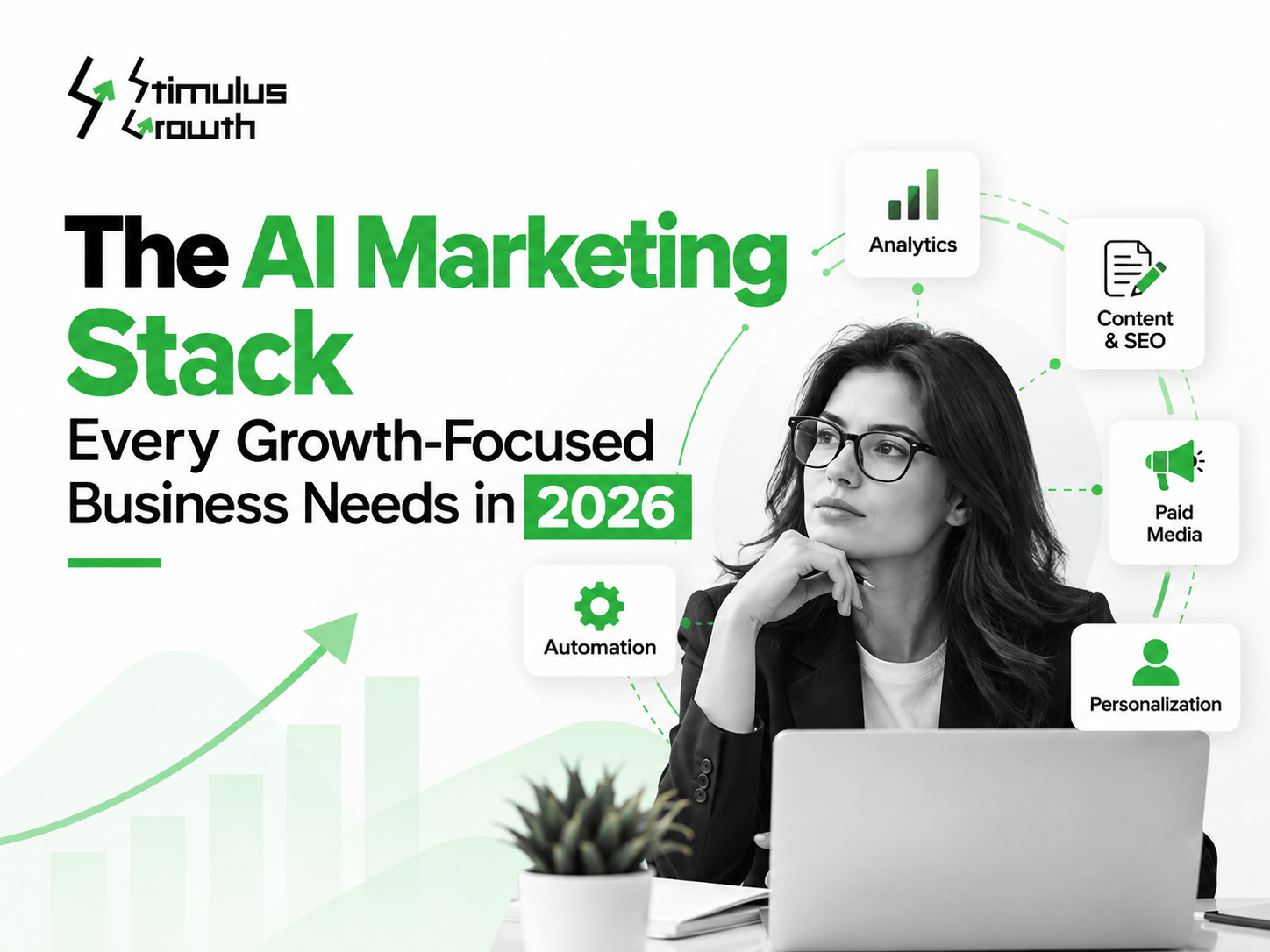
A practical AI marketing stack can be organized around five core areas: data and analytics, content and SEO, paid media, conversion and personalization, and automation. The exact tools will vary by company, but the architecture should remain focused on business outcomes rather than technology adoption for its own sake. When these areas are connected around measurable goals, businesses can build data-driven marketing solutions that turn customer and campaign data into actionable insights rather than leaving each marketing function to operate independently.
Start With Data and Analytics
The first step should be understanding how customers move through the business. Marketing teams need visibility into where prospects come from, what content they consume, which campaigns generate leads, how leads progress through the sales funnel, and which activities eventually contribute to revenue. Website analytics, CRM information, advertising platforms, ecommerce systems, and customer databases should therefore be treated as connected sources of business intelligence rather than separate reporting islands.
Build a Reliable Measurement Foundation
A useful analytics layer should answer more than “How much traffic did we receive?” It should help explain which traffic matters, which audiences convert, which campaigns generate qualified opportunities, and where prospects encounter friction.
For example, imagine two advertising campaigns that generate the same number of leads. One campaign produces inexpensive leads that rarely progress beyond the first sales conversation, while the other generates fewer leads but produces significantly more customers. A marketing stack focused only on lead volume may favor the wrong campaign. A better system connects advertising data with CRM and revenue information so optimization can happen around business value.
Use AI as a Decision-Support Layer
AI should not simply generate another marketing report. Its real value comes from helping teams move from information to action.
A useful workflow might automatically collect campaign data every week, compare performance with previous periods, identify significant changes, summarize potential causes, and present the marketing team with a prioritized list of issues to investigate. The team can then decide whether the correct response is to adjust targeting, change creative, improve a landing page, revise an offer, or leave the campaign unchanged.
Build an AI-Powered Content and SEO Engine
Content remains one of the strongest long-term growth channels, but AI has fundamentally changed how content teams can operate. The old model of researching a topic, writing one article, publishing it, and moving on is increasingly inefficient. Modern content operations need to connect search research, customer questions, content production, optimization, distribution, and performance measurement.
Use AI for Research and Content Planning
AI tools can help marketers organize large amounts of research, identify recurring customer questions, compare competing content, develop topic clusters, create content briefs, and identify gaps in existing resources. SEO platforms can complement this process with keyword data, competitor analysis, backlinks, search visibility, and content-performance information.
The marketer’s role is to turn that information into a useful editorial strategy. Instead of asking an AI tool to “write an SEO article,” the team should determine what the audience needs to know, what existing search results fail to explain, what unique experience the business can contribute, and what action the reader should be able to take after consuming the content.
Optimize for Traditional Search and AI Search
Businesses should therefore monitor traditional rankings alongside visibility in AI-driven search experiences. Content should be written so that both people and machines can understand the topic, relationships, terminology, and key answers without sacrificing readability.
Turn Strong Content Into Multiple Assets
AI also makes content repurposing significantly more efficient. A detailed research article can become a series of social posts, email topics, video scripts, sales enablement material, FAQs, presentation slides, and supporting website resources.
The important point is that repurposing should not mean copying the same paragraph into ten formats. Each format should be adapted to its audience and channel while preserving the original insight. This allows marketing teams to gain significantly more value from high-quality research and expertise.
Make Paid Media More Intelligent
Paid advertising platforms are already heavily dependent on machine learning, but businesses still need to provide good inputs and clear objectives. Automated bidding or audience optimization cannot compensate for poor tracking, weak offers, unclear positioning, or low-quality conversion data.
Improve the Quality of Advertising Signals
Consider a company generating 500 monthly inquiries. If the advertising platform receives only a “form submitted” signal, it may optimize toward people who are most likely to complete forms. But if only 80 of those inquiries are genuinely qualified, the business should ideally provide signals that help distinguish those valuable prospects.
The result is a more intelligent acquisition loop in which advertising decisions are increasingly based on business outcomes rather than surface-level platform metrics.
Use Generative AI for Creative Testing
AI can dramatically accelerate advertising creative production. Marketers can generate multiple headline concepts, hooks, visual directions, scripts, offers, and variations without starting each asset from scratch.
AI can help create and analyze those variations, while human marketers decide what the results mean and what should be tested next.
Avoid AI Tool Bloat
The availability of hundreds of AI marketing tools creates a new problem: too much software.
It is easy to purchase one platform for AI writing, another for content optimization, another for social media, another for analytics, another for automation, and another for reporting. Over time, the business may end up paying for several tools that perform overlapping functions while employees still complete many tasks manually.
Before adding a new tool, ask what specific problem it solves and whether that problem is significant enough to justify another platform. Consider whether the tool integrates with the existing stack, whether its data can be accessed elsewhere, whether employees will actually use it, and how its impact will be measured.
For companies operating across different markets, verticals, or customer groups, technology requirements can also vary significantly. A B2B manufacturer, ecommerce company, healthcare organization, and professional services firm may need very different workflows, which is why digital marketing services for industries should be designed around industry-specific customer journeys rather than a generic technology checklist.
Keep Human Expertise at the Center
AI can analyze more data than an individual marketer, generate content faster, and automate repetitive workflows at a scale that was difficult to achieve previously. But technology does not automatically understand a company’s positioning, customers, competitive advantages, or long-term business objectives.
Human expertise remains essential for deciding what the company should say, who it should target, which opportunities deserve investment, and which recommendations should be rejected.
Organizations building an AI-enabled marketing operation can benefit from our experienced growth strategists when deciding which processes should be automated, which data should be connected, and where human expertise should remain central.
What the 2026 AI Marketing Stack Should Ultimately Achieve
The strongest AI marketing stack is not the one with the most impressive collection of software. It is the one that creates a continuous feedback loop between customers, data, marketing activity, and business decisions.
Analytics should reveal what is happening. AI should help identify patterns and opportunities. Content and SEO should build sustainable demand. Paid media should accelerate acquisition. Personalization should improve the customer experience. Automation should connect these activities so that information moves efficiently through the organization.
Frequently Asked Questions
What is an AI marketing stack?
An AI marketing stack is a connected collection of marketing technologies that use artificial intelligence, automation, analytics, and customer data to improve research, content, advertising, personalization, reporting, and decision-making.
Which AI marketing tools should businesses use first?
Start with tools that solve existing problems rather than adopting software because it is popular. Analytics, CRM, one capable AI assistant, SEO software, and an automation platform can provide a strong foundation for many growth teams.
Can AI replace human marketers?
AI can automate repetitive research, production, analysis, and workflow tasks, but strategic judgment remains essential. Marketing teams still need humans for positioning, creativity, customer understanding, brand decisions, and quality control.
How much should businesses spend on AI marketing?
There is no universal budget. Start with the workflows that create the greatest cost, delay, or missed opportunity, then measure the impact of each investment before expanding the technology stack.
Is AI-generated content good for SEO?
AI can support SEO content when the material is accurate, useful, original, and reviewed by knowledgeable people. Generic, mass-produced content without meaningful expertise or value is unlikely to provide sustainable search visibility.
What should be integrated first?
Analytics, CRM data, conversion tracking, and core customer information should generally come first. These foundations provide the reliable signals needed for effective AI, advertising, automation, and personalization.
How can AI improve marketing ROI?
AI can reduce repetitive work, identify performance patterns, improve audience segmentation, accelerate testing, support personalization, and help teams respond to marketing data faster. ROI still depends on strong strategy and measurement.
What are the biggest risks of AI marketing?
Common risks include inaccurate outputs, poor data quality, privacy problems, excessive automation, inconsistent messaging, and dependence on third-party platforms. Clear governance and human review help control these risks.
Should small businesses use an AI marketing stack?
Yes, but the stack should remain focused. A small business can often achieve significant efficiency with analytics, a CRM, one general AI assistant, an SEO platform, and automation rather than dozens of specialized applications.
How often should a marketing stack be reviewed?
A quarterly review is a practical starting point. Evaluate software costs, adoption, integrations, time savings, campaign performance, and revenue impact, then remove redundant tools or redesign inefficient workflows.