
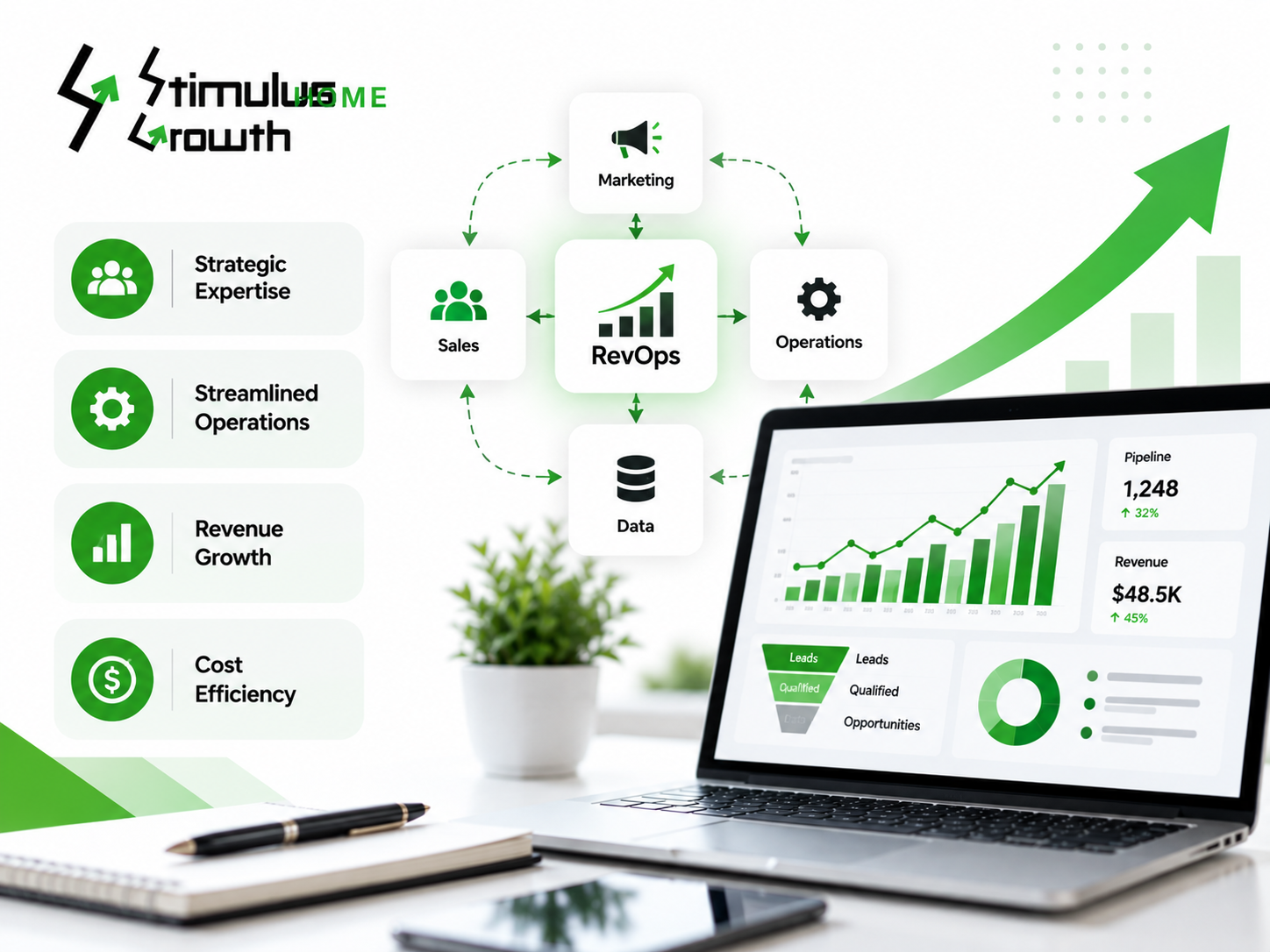
Revenue growth becomes complicated when sales, marketing, and customer success teams work with disconnected systems. Leads get lost, customer information becomes inconsistent, and management struggles to understand what is actually driving revenue.
Fractional RevOps services help businesses solve these challenges by bringing experienced revenue operations leadership into their existing teams.
For growing B2B companies, the objective is simple: improve coordination, streamline technology, and create a predictable revenue pipeline without unnecessary operational complexity.
What Is Fractional RevOps and Why Do B2B Companies Need It?
Fractional Revenue Operations provides businesses with dedicated RevOps expertise on a flexible, part-time basis.
A fractional RevOps consultant works across sales, marketing, and customer success to improve workflows, CRM performance, reporting, and revenue processes.
Unlike traditional departmental management, RevOps focuses on the complete customer journey.
When Does a Business Need Fractional RevOps?
Companies often need RevOps support when marketing generates leads but sales struggles to convert them.
Other warning signs include inaccurate CRM records, inconsistent pipeline reporting, disconnected software, and unclear departmental responsibilities.
Working with a growth agency can strengthen acquisition, while RevOps ensures those opportunities move efficiently through the sales process.
The goal is to build reliable systems that support business growth.
Key Benefits of Fractional RevOps Services
The biggest advantage of fractional RevOps is access to strategic operational expertise without rebuilding the entire revenue team.
A skilled consultant identifies bottlenecks, improves communication, and establishes consistent processes across departments.
Better Sales and Marketing Alignment
Marketing and sales teams frequently define qualified leads differently.
RevOps establishes shared qualification criteria, lead routing rules, and reporting standards.
This helps teams understand which campaigns generate genuine sales opportunities instead of simply increasing lead volume.
Stronger CRM and Technology Integration
Disconnected platforms create duplicated work and unreliable reporting.
Fractional consultants evaluate tools such as Salesforce, HubSpot, Gong, and ChurnZero to identify integration gaps and unnecessary complexity.
Different industries require different customer journeys, so industry marketing should align with the CRM workflows and sales processes supporting each business.
Effective RevOps reduces friction between systems while improving data accuracy and team productivity.
Fractional RevOps vs. Full-Time RevOps Leadership
Choosing between fractional and full-time leadership depends on operational requirements, team maturity, and business complexity.
A fractional RevOps consultant is suitable when businesses need strategic guidance, CRM restructuring, or process improvements without continuous executive oversight.
A full-time RevOps leader becomes more appropriate when revenue operations require daily management across multiple departments.
Choosing the Right RevOps Model
Fractional leadership works particularly well for companies experiencing rapid growth, changing sales processes, or CRM implementation challenges.
Full-time leadership provides deeper day-to-day involvement and continuous ownership.
Both approaches can improve operational performance when responsibilities and expectations are clearly defined.
The right decision should reflect the company’s workload, internal capabilities, and long-term operational priorities.
Step-by-Step Fractional RevOps Implementation Roadmap
Successful RevOps implementation begins with understanding existing problems before introducing new tools or processes.
A Practical 90-Day Implementation Plan
Days 1–15: Audit Revenue Operations
Evaluate CRM data, sales pipelines, marketing attribution, lead routing, and customer handoffs.
Identify where opportunities disappear or processes create unnecessary delays.
Days 16–30: Align Revenue Teams
Establish consistent lead qualification standards, pipeline stages, departmental responsibilities, and reporting requirements.
Days 31–60: Improve Systems and Automation
Optimize CRM workflows, remove duplicate processes, and connect essential platforms.
Effective growth services should support these operational improvements by connecting marketing acquisition with qualified pipeline outcomes.
Days 61–75: Build Performance Dashboards
Create reliable reporting for pipeline velocity, conversion rates, forecasting, and customer retention.
Days 76–90: Validate and Improve
Test automated workflows, review performance, train employees, and document responsibilities.
This roadmap provides a starting framework. Complex integrations and organizational changes may require additional time.
Measuring the Success of Fractional RevOps
RevOps success should be measured through improved business performance rather than the number of workflows created.
Five Essential RevOps Metrics
Pipeline Velocity: Measures how efficiently opportunities move through the sales process.
Lead Conversion Rate: Tracks how effectively qualified prospects become customers.
Sales Cycle Length: Identifies how long opportunities take to close.
Forecast Accuracy: Compares projected revenue against actual outcomes.
Customer Retention: Measures how successfully businesses maintain customer relationships.
A successful RevOps strategy improves visibility across these indicators and helps teams identify operational problems earlier.
Experienced RevOps specialists can help establish reporting standards, clarify responsibilities, and align business objectives with execution.
Companies planning revenue operations improvements can request a RevOps consultation to evaluate existing workflows and growth priorities.
Ultimately, fractional RevOps is about creating a business where marketing, sales, and customer success operate as one connected revenue system.
Frequently Asked Questions
1. What are fractional RevOps services?
Fractional RevOps services provide flexible revenue operations expertise to improve CRM systems, sales processes, marketing alignment, and reporting. Businesses receive strategic guidance without establishing a dedicated internal RevOps department.
2. What does a fractional RevOps consultant do?
A fractional RevOps consultant evaluates revenue workflows, improves CRM data, identifies pipeline bottlenecks, and aligns sales, marketing, and customer success teams around consistent processes and performance objectives.
3. What are the main benefits of fractional RevOps?
Key benefits include stronger departmental alignment, improved CRM accuracy, streamlined workflows, clearer reporting, and better pipeline visibility. These improvements help businesses make informed revenue decisions.
4. Is fractional RevOps suitable for startups?
Yes. Startups experiencing growing sales complexity can benefit from fractional RevOps expertise. It helps establish reliable systems, qualification standards, and reporting processes before operational problems become difficult to manage.
5. Which CRM platforms work with fractional RevOps?
Fractional RevOps consultants commonly work with Salesforce, HubSpot, and related marketing automation platforms. Platform selection depends on business requirements, existing integrations, and the complexity of revenue workflows.
6. How does fractional RevOps improve sales performance?
Fractional RevOps improves lead routing, qualification standards, pipeline reporting, and team coordination. These changes can reduce operational delays and help sales representatives focus on qualified opportunities.
7. Can fractional RevOps improve customer retention?
Yes. Better customer handoffs, onboarding workflows, and retention reporting can help teams identify service problems earlier. Actual retention improvements depend on customer experience, product quality, and execution.
8. How long does RevOps implementation take?
Initial improvements may be introduced within several weeks, while broader operational changes can require several months. Timelines depend on CRM complexity, data quality, integrations, and organizational readiness.
9. What is the difference between RevOps and SalesOps?
SalesOps focuses primarily on sales processes, reporting, and productivity. RevOps connects sales, marketing, and customer success to establish shared data, coordinated workflows, and consistent revenue accountability.
10. How can businesses measure RevOps success?
Businesses should monitor pipeline velocity, lead conversion rates, sales cycle length, forecast accuracy, and customer retention. Comparing performance against an established baseline helps evaluate operational improvements.