
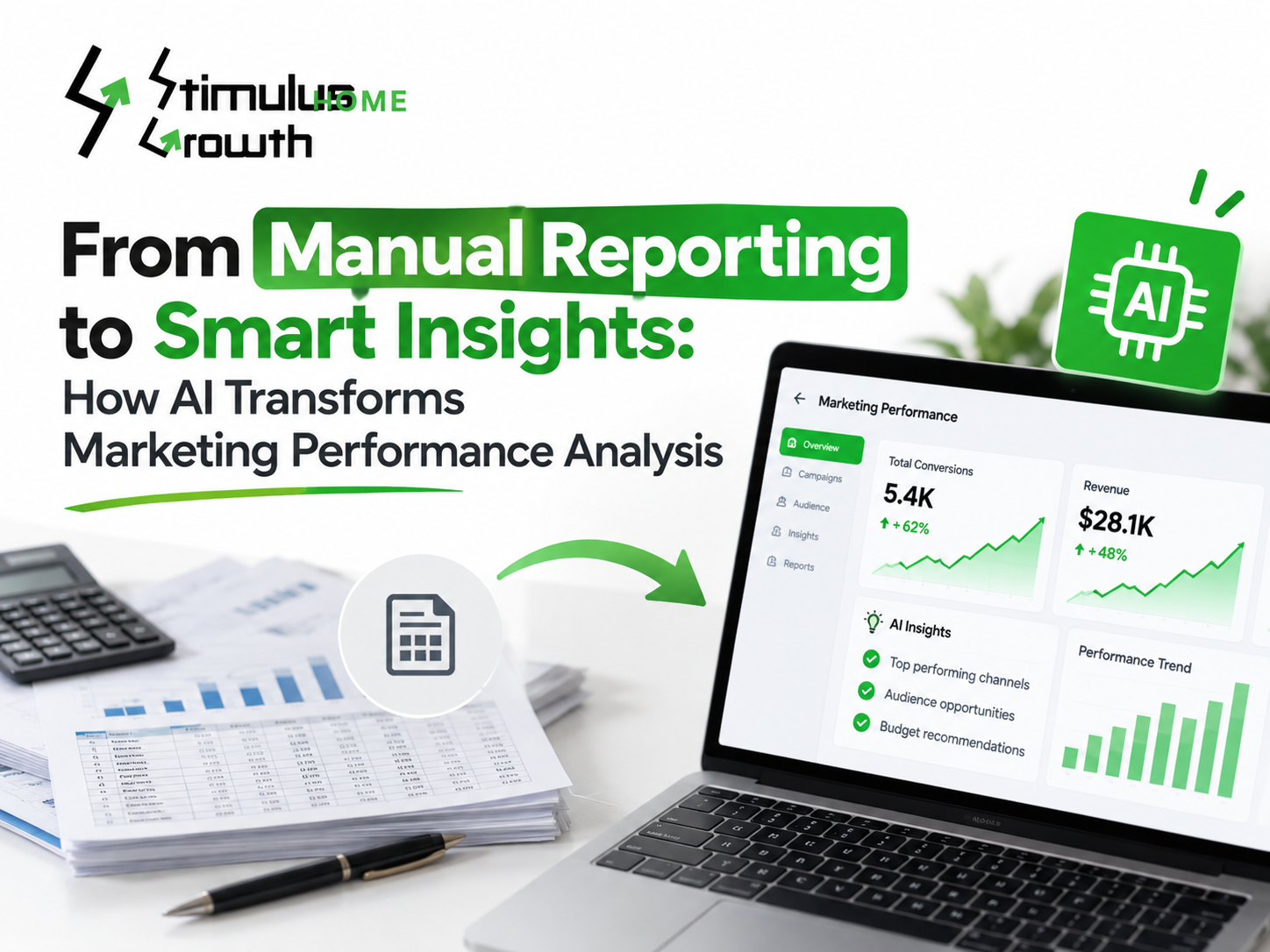
It’s Monday morning, and your marketing team is preparing its weekly performance report. Someone is exporting data from Google Ads, another person is checking Meta campaigns, and someone else is updating spreadsheets with website traffic and conversion numbers.
By the time everything is organized, several hours have passed. The report looks complete, but one important question remains unanswered: What should the team actually do differently? This is where traditional reporting often falls short. Marketing teams spend so much time collecting information that they have little time left to understand what it means.
AI marketing analytics is changing that process. Instead of manually combining reports and searching through endless numbers, businesses can use automated systems to organize performance data, identify unusual changes, and discover opportunities that deserve attention. For marketing leaders, the real benefit is not simply saving time. It is making better decisions while those decisions can still influence campaign performance.
Why Manual Marketing Reporting Slows Down Growth
Manual reporting may seem manageable when a company runs only a few campaigns. However, as marketing activities expand across search, social media, email, and organic channels, reporting becomes increasingly complicated.
Every platform measures performance differently. Google Ads reports advertising conversions, Meta provides its own attribution data, and Google Analytics tracks website interactions using different measurement rules. When teams combine these numbers without understanding the differences, they risk creating reports that look accurate but tell an incomplete story.
Too Much Time Goes Into Collecting Data
Consider a marketing manager responsible for campaigns across several platforms. Before reviewing performance, they must download reports, organize campaign names, check spending, calculate conversion rates, and update dashboards.
This process becomes repetitive, particularly when the same reports are prepared every week. Even small spreadsheet mistakes can affect the numbers presented to management. A better reporting process reduces manual work so marketers can focus on campaign performance rather than administrative tasks.
Delayed Reports Lead to Delayed Decisions
Imagine discovering on Friday that a campaign started wasting money on Monday. The issue may have been visible in the data, but nobody noticed because the report was not scheduled until the end of the week. Automated marketing reporting helps reduce this delay by updating available performance information more frequently and alerting teams when important metrics change.
Working with a marketing agency can help businesses connect these insights with practical optimization decisions that improve campaign efficiency.
Why Traditional Marketing Dashboards Are Not Enough
Dashboards make marketing data easier to view, but they do not automatically explain why performance changes.
A dashboard might show that conversion rates dropped or customer acquisition costs increased. However, it may not explain whether the cause was rising competition, changes in audience behaviour, creative fatigue, or a website issue. Someone still needs to investigate.
Another challenge is fragmented data. A business might see strong results inside individual advertising platforms while overall sales remain relatively unchanged. Different attribution methods can make it difficult to understand how channels contribute to the same customer journey. This is particularly important for companies running campaigns across several markets. Their reporting requirements may vary depending on customer behaviour, sales cycles, and marketing objectives.
Effective industry marketing requires reporting that reflects these differences rather than relying on identical performance metrics for every business. A useful analytics system needs to go beyond displaying numbers. It should help teams understand what changed, why it might have happened, and which areas need further investigation.
How AI Turns Marketing Data Into Useful Insights
AI marketing performance analysis combines automated data processing with statistical methods and machine learning to identify patterns in campaign performance. Instead of expecting a marketing manager to review every metric manually, an AI supported system can highlight changes that may deserve attention.
Identifying Patterns Across Marketing Channels
Suppose website conversions increase whenever paid search traffic and email engagement rise together. A traditional report might show these figures separately, leaving the marketing team to discover the relationship.
AI analytics can help identify recurring patterns across connected datasets and make them easier to investigate. These findings can reveal useful relationships between marketing activity, customer engagement, and business outcomes. However, a pattern does not automatically prove that one channel caused another to improve.
Detecting Campaign Problems Earlier
Anomaly detection is one of the most practical applications of AI in marketing analytics. For example, a campaign normally generates leads at a consistent cost. Suddenly, its acquisition cost rises significantly while conversion volume declines.
An automated system can compare the latest results with historical performance and flag the unusual change. The marketing team can then investigate possible causes, including tracking errors, audience fatigue, landing page problems, or increased auction competition.
Predicting Potential Performance Changes
Predictive marketing analytics uses historical data to estimate possible future outcomes.
A business might use forecasting models to estimate expected lead volume, advertising costs, or customer acquisition trends based on previous performance.These predictions can support budget planning and help marketers prepare for potential changes.
However, predictions are not guarantees. They depend on data quality, historical patterns, and market conditions. Human judgement remains essential when making significant budget decisions.
Building an AI Marketing Reporting System That Works
Moving from manual reporting to automated insights does not require replacing every marketing tool. A practical approach is to connect existing platforms, standardize important metrics, and automate repetitive reporting tasks before introducing more advanced AI analysis.
Connect Your Marketing Data Sources
Start by identifying where your important performance information is stored.
For many businesses, this includes Google Analytics, Google Ads, Meta Ads, customer relationship management software, and ecommerce or sales systems. Available APIs and approved integrations can help bring these datasets into a central reporting environment.
For example, the Google Analytics Data API supports programmatic reporting, allowing businesses to retrieve analytics information for custom dashboards and reporting workflows. Before combining datasets, marketers should ensure campaign naming conventions, date ranges, currencies, and attribution settings are consistent.
Validate Data Before Running AI Analysis
If conversion tracking is incomplete or multiple platforms count the same purchase differently, an automated dashboard may reproduce those problems.
A reliable reporting system should check for missing records, unusual values, duplicate transactions, and inconsistencies between advertising and sales data. It should also distinguish between metrics that update frequently and those that require additional processing time. This makes reports more dependable and reduces the risk of acting on incomplete performance information.
Define Metrics That Matter to the Business
A marketing manager may monitor engagement rates and website traffic, while a CMO may care more about customer acquisition costs, revenue contribution, and marketing efficiency. Reporting should reflect these different responsibilities.
Our marketing services connect campaign measurement with business objectives, making it easier to identify which activities contribute to meaningful outcomes.
Add Automated Alerts and AI Summaries
Once data is connected and validated, businesses can introduce automated reporting workflows.
A reporting system might refresh campaign information at scheduled intervals, calculate changes against previous periods, and notify the marketing team when a metric moves outside an expected range. AI can then help explain the context around these alerts using available data.
For example, an alert might identify rising acquisition costs in a particular campaign while showing that landing page conversion rates also declined.
Turning AI Insights Into Better Marketing Decisions
The value of AI analytics becomes clear when marketing teams use its findings to improve campaigns rather than simply producing more reports.
Suppose automated reporting identifies that one Google Ads campaign is attracting traffic but generating fewer qualified leads. At the same time, another campaign has a higher cost per click but produces better sales opportunities.
Instead of automatically moving the budget toward cheaper traffic, marketers can compare lead quality, conversion performance, and commercial outcomes. They might discover that the more expensive campaign is actually delivering better customers.
The same principle applies to creative performance. If an AI system identifies a decline in engagement with particular advertisements, marketers can review audience frequency, test new messages, and evaluate whether the offer remains relevant.
AI provides information that supports these decisions, but it should not make every strategic choice independently. With guidance from our analytics experts, businesses can develop reporting workflows that combine automation with practical campaign management and human oversight.
Make Marketing Reporting More Valuable to Your Business
Marketing reporting should help businesses understand what is working, where money is being wasted, and which opportunities deserve attention. AI can make this process faster by reducing manual data collection, highlighting unusual performance changes, and turning complex information into clearer insights.
However, successful implementation starts with reliable data, meaningful metrics, and clear business goals. Without those foundations, even advanced reporting tools can produce misleading recommendations.
If your team spends too much time preparing spreadsheets and not enough time improving results, you can contact our team to discuss your reporting challenges and identify opportunities to build a more efficient analytics process.
Frequently Asked Questions
What Is AI Marketing Analytics?
AI marketing analytics uses machine learning and automated data analysis to identify performance patterns, detect unusual changes, and support marketing decisions. It helps teams understand campaign results without relying entirely on manual reporting.
How Does AI Reduce Manual Marketing Reporting?
AI reporting systems can collect available campaign data, calculate performance metrics, and generate summaries automatically. This reduces repetitive spreadsheet work and allows marketers to spend more time investigating results and improving campaigns.
Can AI Combine Data From Google Ads and Meta Ads?
Yes. AI reporting systems can analyse information collected from Google Ads, Meta Ads, and other connected platforms. However, businesses must standardize metrics and understand attribution differences before comparing performance accurately.
Is AI Marketing Reporting Accurate?
AI reporting can be useful when connected to reliable and properly validated data. Accuracy depends on tracking quality, integration settings, and analytical methods. Teams should review important findings before making major marketing decisions.
What Is Predictive Marketing Analytics?
Predictive marketing analytics uses historical data and statistical models to estimate future trends, such as potential conversion volume or acquisition costs. These forecasts support planning but cannot guarantee future campaign results.
Can Small Marketing Teams Use AI Reporting Tools?
Yes. Small teams can begin with automated data connections, scheduled dashboards, and simple performance alerts. A gradual approach helps reduce reporting work without requiring an expensive or complicated analytics infrastructure.
How Does AI Detect Marketing Performance Problems?
AI systems can compare current campaign metrics with historical patterns and identify unusual changes. For example, sudden increases in acquisition costs or falling conversion rates can trigger alerts for marketers to investigate.
Can AI Improve Cross Channel Marketing Attribution?
AI can support attribution analysis by evaluating customer interactions across connected channels. However, platform tracking limitations and different attribution rules mean marketers should not treat AI attribution estimates as definitive proof of impact.
Is Customer Data Safe in AI Marketing Analytics?
Data security depends on the tools, permissions, storage methods, and privacy controls used. Businesses should limit sensitive data exposure, review vendor policies, and ensure reporting workflows meet applicable data protection requirements.
How Long Does It Take to Implement AI Marketing Reporting?
Implementation time depends on the number of platforms, data quality, and reporting complexity. A basic automated dashboard may be relatively quick to establish, while advanced integrations and predictive analytics usually require additional preparation.